
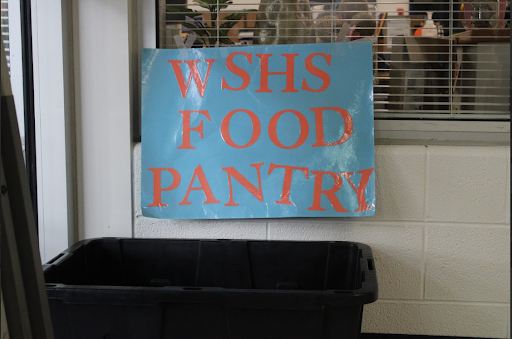
Located in a tiny corner of the first floor, the Spartan Pantry is a food pantry that provides food and hygiene products to WS students. Started in 2016, the pantry is an integral part of WS’s community, providing resources to many families every year.
Employment and Transitions Representative Rebecca Cousins was one of the pioneers for the pantry. Along with WS’s former College and Career Specialist Tessa Fredrick and a boy scout, Cousins established WS’s first food pantry.
“A boy scout approached Frederick and I to start a food pantry at the school. We wanted to make sure that no WS student was going hungry,” said Cousins.
To supply the pantry, Cousins gets the majority of the donations from an organization called Food For Neighbors, more commonly known as FFN. FFN is a large non-profit organization that does large food drives to help students with food insecurities.
FFN holds food drives in the neighborhood and partners with Irving Middle School. We work with them to donate food to our food pantry. Additionally, clubs and organizations will hold food drives to restock our food pantry,” said Cousins.
Stocking the pantry also involves deciding which items to prioritize and include.
“We select foods that are non-perishable. Especially things like cereal, granola bars, tuna fish, peanut butter and jelly, macaroni and cheese, pasta sauce, pasta, microwavable dinners that don’t have to be refrigerated. We also have some toiletry items. I don’t believe SNAP benefits cover hygiene products, so we have sanitary pads, deodorant, shampoo, conditioner, toothpaste, soap and dental floss,“ added Cousins.
After receiving these donations from FFN, Cousins works with WS’s special education program to stock and organize the pantry.
“The special education students help stock the food pantry while learning vocational skills like identifying expiration dates on the items, sorting the food into categories, putting them on the shelves and fronting the items on the shelves,” said Cousins.
After the pantry is adequately stocked, it operates much like a regular supermarket. Students come in and just choose the items they need.
“If students are in need of food, they can talk to their school counselor or school social worker to let them know they need some help. The food pantry is meant to be short-term support and the school social worker can help the family learn more about different food pantry options out in the community,” said Cousins.
Another important component of the pantry are social workers. They support students in accessing the pantry and ensure families have the resources they need.
“Social workers connect families and students in need with the food pantry. When a student or family reaches out for support, we offer our list of community resources, as well as access to the pantry. Sometimes teachers also notice a financial need and they ask one of the social workers to follow up with the family to confirm that need,” said WS social worker Dianne Stansbery.
In addition to giving students the ability to access food and hygiene products with ease, the pantry also represents WS’s community values.
“I think having the food pantry demonstrates that we really look at students as whole people, not only focused on their academic success but their health and well being too,” said Stansbery.
Cousins also echoes these sentiments, emphasizing the fact that it’s a privilege to give students the resources they need.
“I appreciate that we have something for families in need when they need it the most, and then have them be able to get additional resources of the food pantry options out in the community,” said Cousins.
Through running the pantry and creating a supportive community within WS, Cousins and Stansbery have seen it make a difference in the lives of many families.
“We have had several families each year seek support from the pantry. The families appreciate the ease of access to the pantry and we always try to make their visit private and confidential,” said Stansbery.
An important aspect in keeping the pantry running is confidentiality. To ensure students are able to access the resources without fear of stigma, discretion is a key factor.
“We are discreet about who uses the food pantry. That information is confidential,” said Cousins.
However, despite its apparent benefits, the Spartan Pantry is one of the lesser known resources at WS. A large portion of students don’t even know it exists.
“I have never heard of the pantry. I didn’t know this was a resource offered to students.” said senior Semawit Varghese. “I think the school should promote it better so more students can access it.”
Still, the pantry is a resource that is available to any student in need. Students can contact their counselors, social workers or even Cousins to access it.
“I think some students feel comfortable but others who may have needs, do not ask for any help. I wish any student in need would feel comfortable asking for this help and know that they will not be judged,” said Stansbery.
At the end of the day, the Spartan Pantry is a valuable and essential resource offered to students. Operating through the close collaboration of various staff and students, the pantry reflects the strong and supportive community that is WS. Though it is a lesser known resource, students should always feel free to ask for access to the pantry.