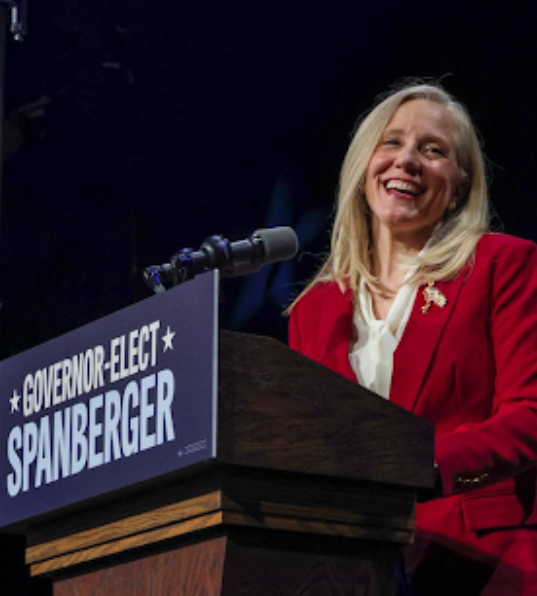
Recently, Democrat Abigail Spanberger was elected as Virginia’s first female governor, ending a 400-year history of male executive leadership. This historic achievement not only breaks a significant gender barrier but also opens new political possibilities within the state.
Even though this is a big historic achievement, this also serves as a reminder of historical barriers women have faced on the road to executive power.
For centuries, women in Virginia and across the nation were systematically excluded from executive positions, limited by stereotypes, social norms and unequal access to financial and political support. Misconceptions that women are too emotional or less capable than men have long discouraged qualified candidates from running for office.
Women’s History Teacher Joanne Pendry explains some of the factors that contributed to this delay.
“I think there’s a lot of mischaracterization, like concerns that she might be neglecting her other roles,” Pendry said. “People may also worry that women can’t secure donors or funding, which is always a big challenge.”
She also adds that there are some stereotypes about how women are emotionally weaker than men.
“There’s a belief that women might be more emotional and less rational than men,” Pendry said. “Some people see a woman in office as less capable, which is a stereotype women have had to fight against for years.”
Spanberger’s election represents more than a political milestone, it reflects a broader shift in how women are perceived in leadership roles.
Pendry emphasizes the importance of female representation.
“When young women see others in leadership, it challenges old assumptions about who belongs in government,” said Pendry. “It shows students that leadership roles are attainable and can inspire them to aim higher than they might have before.”
While Virginia is not the first state to elect a female governor, Spanberger’s victory, and the election of the state’s first female lieutenant governor, Ghazala Hashmi, marks progress in breaking long-standing barriers. According to Pendry, this moment highlights how society is gradually recognizing the strengths and capabilities of women in high-ranking positions.
Students are already noticing the impact. Junior Aminah Qureshi said the election changed her perception of what is possible.
“It’s so crucial for women to have representation in powerful places like the government,” she said. “It challenges the stereotypes that women cannot take on leadership roles and allows younger women like myself to look up to women like Abigail Spanberger and realize we are just as capable,” said Qureshi.
The influence of Spanberger’s election extends beyond the classroom. For example, student interns at the local offices have shared how seeing a woman lead the state inspires them to think differently about their own ambitions.
The election is also expected to influence policy and public discourse. Spanberger has signaled priorities such as increasing access to reproductive rights, which Qureshi said will reshape conversations around women’s issues in the state.
Beyond policy, the symbolic importance of seeing women in positions of power cannot be overstated, it motivates more women to run for office and pursue leadership roles in fields that have historically been male dominated.
While this historic victory is cause for celebration, challenges remain. Gender stereotypes, unequal funding opportunities, and societal biases still create barriers for women seeking office. Still, Spanberger’s election offers hope that these obstacles can be overcome and that Virginia may serve as a model for broader gender equity in politics.