There are many names that Northern Virginian residents have for their area: “NoVa,” “the DMV,” “traffic county.” But the country came up with a different name: “data center alley.” Corporations are setting up massive data centers in Burke’s backyard, and, according to recent polling, 92% of residents have no idea, either of their presence or their impact on everyday life.
What is a data center anyway?
In the traditional sense of the word, a data center is a facility designed to house physical components of business data, like emails, documents, and other stored files. Artificial Intelligence (AI) applications require data centers dedicated specifically to their application in order to process their computations and provide the energy they need to function.
Because of the number of high-performance processing units required to operate an AI application, these centers are often much larger and consume more energy than traditional data centers. While AI data centers are becoming increasingly common, not every center is specifically for AI work, which is a common misconception.
Why Virginia?
Dating back to the late 20th century, Arlington was one of the first places to begin data transfers, mostly between the Pentagon and major universities. This endeavor influenced the expansion of data networks across the US and set the foundation for the development of the area over the next half century.
When the web was first being developed, northern Virginia was eyed by global companies as an ideal place to set up internet exchange points, physical hubs that improved internet speed by allowing data to travel directly between providers. Boasting proximity to both a metropolitan area and residential neighborhoods, a geographical location with low occurrences of natural disasters, and lower regulations than a typical urban area, northern Virginia was the perfect place to establish these internet exchange points.
As the data industry grew, these points started to be transformed into data centers, since they were already well-established and physically close to large cloud and data service providers. The local power provider, Dominion Energy, also charged data centers in the area 28% less than the national average at the time, making it more affordable to expand infrastructure. Additionally, the high demand for water is satiated by the nearby Potomac River.
What are the effects?
Data centers and the effects they have on communities are both projected to grow in the coming years, in response to an increasing demand for data storage and AI tools.
Employment in centers increased by more than 60% across the US between 2016 and 2023, with the number of people working in data centers growing from 306,000 to 501,000. The large demand for employment is one of the biggest appeals for centers.
Data centers already use a significant amount of electricity just to stay on. Four percent of the nation’s electricity was used by data centers in 2023— more than the whole state of New Jersey— and that number is expected to keep going up, likely becoming 6-12% by 2030. Regular online searches use one-tenth the amount of energy as a single generative AI prompt (like ChatGPT or Google’s AI Overview).
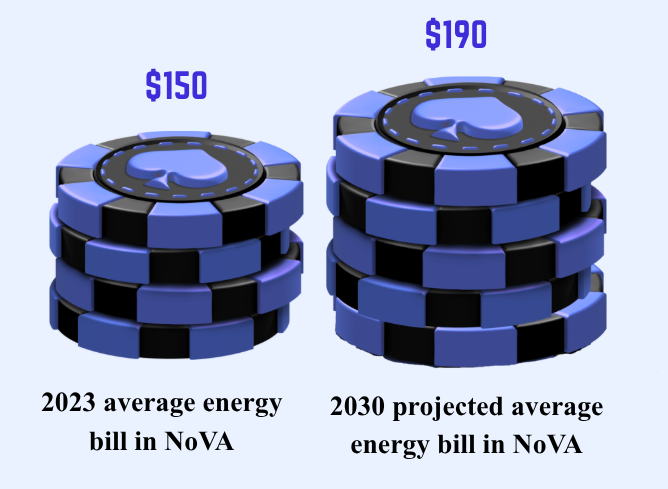
Because the centers draw energy from their local power grid, it puts strain on it, raising prices for local residents. Reston, Vienna, and Chantilly (where many centers are located) all rely on the same power grid as Burke and Springfield residents, meaning all the electricity bills in that area will likely skyrocket.
Consistently loud sounds like HVAC systems, machinery, or construction— also known as noise pollution— can negatively affect local communities and wildlife. The constant sounds can be a stressor, cause hearing loss or tinnitus, and interfere with animal breeding, navigation, and predator detection.
Gas powered data emit large amounts of chemicals like nitrogen oxides, methane, and microscopic inhalable particles. Because of their small size, they can easily be respirated, breathed in, and absorbed into the bloodstream. Exposure to these chemicals significantly increases risk for cardiovascular conditions, respiratory diseases, and cancer, as well as increasing overall preventable deaths.
What now?
Data centers are primed to expand across the US at a rate similar to the spread of the internet. As AI usage increases, so will the presence of these centers. There are ways to mitigate the risks that accompany expansion, though.
To decrease the use of local freshwater resources, centers could adopt closed-loop cooling systems, which recycle water instead of continuing to draw it. If centers were built underground, they could also take advantage of the naturally colder environment to diminish the demand for cooling systems. Utilizing renewable energy sources would reduce the strain on local power grids and lower the environmental footprint.