AP and DE classes have always been common for students at West Springfield High School to take. Although, taking these classes brings up the question, why bother?
Senior Michael Collins, who in total has taken 7 APs and 3 DEs through his high school career, shares how he believes DE classes provide college-related experiences that aren’t easily accessible otherwise.
“I took Teachers for Tomorrow, which is a DE class, because I thought it’d be really fun. They let you get hands-on teaching experience that a lot of other classes just can’t provide. It’s similar to how an academy lets you physically work on cars, which you wouldn’t do on any normal day,” said Collins.
Collins also adds that taking a DE class can be beneficial for a subject that is not a favorite and wants to be avoided in the future.
“I don’t really like English that much, and I don’t want to take it in college, so doing a DE English class gets me out of that. On top of that, [DE English] gives you access to all of the college databases and stuff, so that just makes it really convenient, basically having all of NOVA just at your fingertips.” said Collins.
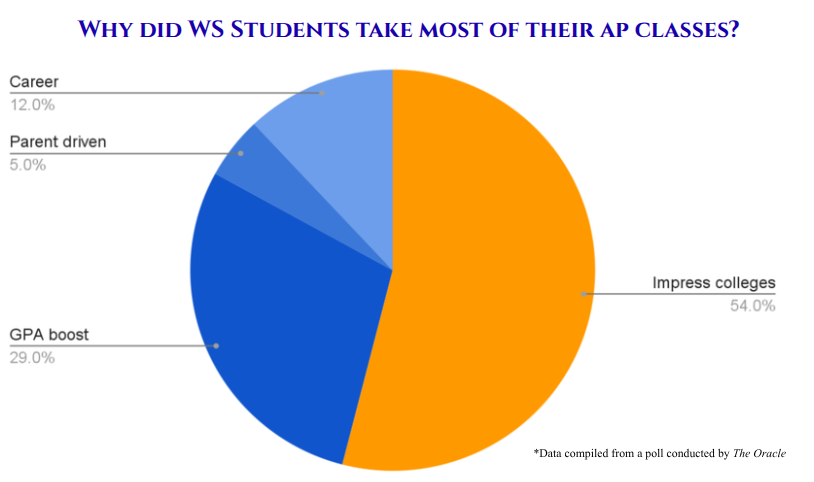
While some may want to avoid subjects, others aim to pursue passions through AP classes. These classes provide not only a preview of possible career paths, but also a chance to grab the attention of colleges.
“I want to be a physicist and astronomer, so some of the APs I’ve taken, like Physics, Calc, and Chemistry, are related to what I’m planning on majoring in college,” said senior Timothy Campbell. “But then some of them, like Lit, Lang, Seminar, and Research, aren’t as closely related, so I just took them to stand out.”
Among the benefits provided from AP classes is a 1.0 point GPA boost, so taking them as soon as possible isn’t uncommon. Once reaching junior year, the possibilities for taking classes in relation to a future desire increases. Junior Kyler Gabrano shares how he benefits from taking AP classes, but also acknowledges the limits that come along with it.
“Some classes don’t offer an AP option, even if you wanted to take it because it relates to something you want to do in the future,” said Gabrano. “I want to be an engineer, so I chose to take harder math and physics classes. Although, some of the other AP classes I chose were honestly just for a GPA boost.”
The GPA boost from AP classes is heavily desired among students at WS, yet not every student feels the commitment is necessary. AP Lang and English 11 Honors teacher Leana Jensen shares the noticeable difference in environment between her classes.
“Some students are [in honors classes] because they were too anxious to take an AP or DE English class, or weren’t really sure about it. Some are there because their parents are making them, and they think they’re better on that level,” said Jensen. “Meanwhile, my AP classes are far more ready for debate, discourse, conversation, and participation. There’s higher stakes, they’re here looking for free college credit, and that’s my goal, to get them some free college credit.”
Collins adds that there isn’t a definite loss when it comes to taking an AP class, and there isn’t much of a difference as long as the effort is put in.
“A 1.0 GPA boost is huge, and I haven’t even noticed if it’s harder,” said Collins. “Last year, the class that I got the lowest grade in was regular astronomy. I was taking AP Physics and AP Precalc, and I still got a lower grade in my regular astronomy class.”
However, Gabrano believes that not only is the material more challenging, but the pacing of an AP class is hard to manage.
“Most classes may seem fast, but with APs, it’s content that’s already harder to understand, then on top of that it goes so much faster,” said Gabrano.
Jensen believes the teaching aspect of an AP class is all about the process, especially with students that may have different goals when first stepping into class.
“I always say AP Lang is like, rough start, smooth finish. Sometimes it takes awhile to learn skills, but I really do enjoy seeing my students gain their confidence,” said Jensen. “I’ve had students say they legitimately want to work on their writing skills. Perhaps they’re very STEM minded, and they just want to be better writers, which I think is great for my future lawyers of America.”
Collins shares how the difference in environment is humbling, and that advanced classes should open up the minds of students in realizing how much more work is dependent on the worker.
“It’s not like you’re being babied, you’re actually being expected to learn things and think for yourself. Even when I get stuff wrong, I know that I did it wrong. It’s not like a memorization problem or something else I can blame, it’s like, ‘oh yeah, I had to use my brain, and I used my brain wrong,'” said Collins.
Senior Reed Johnson believes AP classes feeling more challenging is normalized, despite any specific reason as to why a student would take an advanced class. To balance the strenuous content given by AP courses, the providence of study and practice material is considerably large.
“[AP/DE classes being harder] makes sense, because AP/DE classes are supposed to be more difficult by design. However, an advantage AP classes have over regular or honors classes is just how many resources are available online in the form of review videos, practice tests, and entire curriculum layouts,” said Johnson.
AP classes being national supports the students by providing the necessary subject matter. Yet Johnson admits that AP classes aren’t as popular when it comes to interest in future careers, but more so the desire to be the best.
“Because of how important they are to get into top colleges, [AP classes] are really the only choice,” said Johnson. “I think that this undermines the value of the promised ‘advanced’ education that these classes provide, as I’ve forgotten about almost everything I’ve learned from the AP classes I took last year.”
Campbell agrees that the main priority for most students is to impress, even if there’s not an interest in the AP classes taken in order to rise to the top.
“I think most people aren’t taking classes like AP Art unless they’re really interested in art, but a lot of people will take Lit or a history AP despite not planning on being English or history majors. You just have to stand up for college admissions and part of that is through having a higher GPA and higher rigor,” said Campbell.
The pressure of wanting to stand out during college admissions can turn course selection into a competition.
“I feel like most of the kids I talk to seem like they only care about their colleges or like how good they look on their applications. In that sense, it is kind of a game where people are just trying to see who can take more AP classes,” said Collins.
Johnson is a prime example of what Collins believes to be true.
“I chose to take AP math courses because I love math, especially statistics, but the main reason I took as many APs as I did was because it looks good for colleges and I just wanted to raise my academic rigor,” said Johnson.
On the contrary, senior Audrey Cortright believes more in challenging herself than proving herself to others.
“I chose to take AP classes because I wanted to push myself and learn more about my favorite subjects like psychology and history,” said Cortright. “I know a lot of people who are super interested in college level classes and the subjects offered at those levels.”
These subjects not only offer advanced options, but the opportunity to gain passion for a specific topic, even if unintentional. Junior Samantha Englert shares how AP art opened her mind up to new possibilities.
“AP Art is very independent, there’s not a teacher telling you what to create or how to create it. You choose all of your projects which is very fun,” said Englert. “Art has always been a big part of my life, and now after taking so many art related classes, I want to minor in it in college.”
Each AP class isn’t just designed for the subject, but the student who aims to take it as well. Jensen believes every course provides different life skills, and confidence is key in obtaining those skills.
“[AP Lang] is a great class for those who want to study argument and those who want to challenge themselves. You learn rhetoric, critical thinking skills, and the way the curriculum is set up is truly rigorous,” said Jensen. “I’m confident in my teaching skills, and I know that if we work together, students can go from a two to a five [on the AP exam] because I’ve seen it every year. It’s possible, but the responsibility is on the student and if they want to put in the effort.”
Cortright agrees that effort is key no matter the reasoning as to why a student would take an AP class. If the effort is not there, it is more likely a student will fall behind.
“The level of effort you need to put into an AP class is a lot different than a regular or Honors class. There’s a lot more individual work you need to complete outside of school and there is much more vocabulary and concepts that need to be memorized,” said Cortright.
Students’ reasoning for taking AP or DE classes vary widely, ranging from genuine interest in a subject to the pressure of building a competitive college application. While advanced classes can open doors to deeper learning and future opportunities, they also reflect the growing pressure students feel to perform. Whether driven by passion or practicality, students are navigating a system where achievement is often measured by how much they can handle.