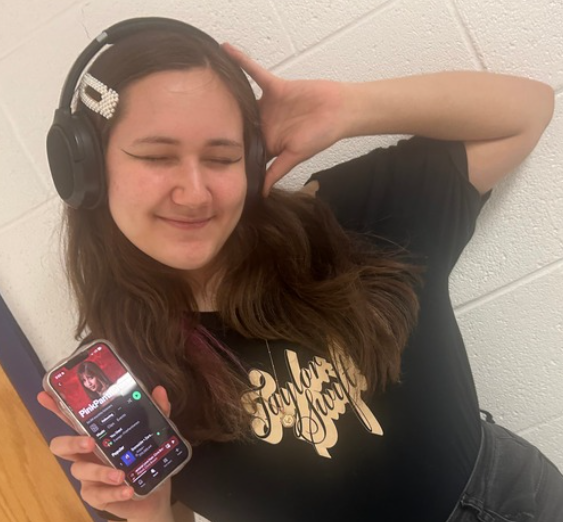
If one were to share an AirPod with the ordinary WS teenager, they would most likely hear a two minute song that would otherwise be unrecognizable if it weren’t for the chorus. This new trend consuming merely surface-level slop that was only produced with the intention of going viral on Tiktok has begun altering the idea of what good music is.
“I feel like there are less songs that genuinely reflect an artist’s ability, and instead seems to rely entirely on the fact that their cult-like following will love whatever they make, even if it isn’t truly a good song/album,” said senior Oriana Laney. “This, combined with the simple fact that shorter songs take less effort to create, means long songs aren’t being made because fans aren’t holding their favorite artists to higher standards anymore, allowing them to create albums that have only two minute songs.”
Short video platforms such as Instagram reels, YouTube Shorts, and Tiktok, provide endless entertainment for teenagers with the attention span of a zombie. Since these apps are music based, many artists take advantage.
“TikTok and YouTube Shorts are to blame for the flood of shorter songs. Once record labels noticed that influencers and viral videos were causing songs to go viral, there was plenty of incentive to crank out shorter songs in the hopes that one would go viral. Due to the random nature of ‘viralness’, there is a major incentive to cast a wide net with ‘quantity over quality,’” said guitar and choir teacher Dustin Brandt.
One of the main culprits of this recent trend of short songs is pop artist PinkPantheress, who rose to fame because of the short video app and claims that, “no song needs to be longer than two minutes and thirty seconds,” according to MusicTech.com. A common argument is that the length of a song depends on the genre.
“Sometimes shorter songs can feel repetitive and unfinished if it’s only relying on one gimmick, like an instrumental or certain verse/phrase to carry the song- it can lack substance and leave listeners unsatisfied. Although, I do think the context of that is subjective. In some cases, I think this works very well within certain approaches. I think [PinkPantheress’] songs are good length. It’s vibey pop music, and it does what it needs to do in a short amount of time,” said senior Sarah Buchholz.
However, as artists like PinkPantheress promote the idea that songs should be capped at the two minute mark, it minimizes the overall creativity that music was once known for, and creates less of an immersive experience.
“I like listening to longer songs because I feel like I get to fully immerse myself in the music. They require artists to be more creative, which makes the music more enjoyable. Although I do sometimes enjoy shorter songs, like interludes, I think that the longer a song is the better,” said Laney.
Another recent trend that goes hand in hand with the snippets that are disguised as songs, is AI music.
“As a musician and a songwriter, I find little to no value in AI music. I like to create music merely because I love the process of creating. I respect, appreciate, and support artists that create good music. Music allows us, as humans, to profoundly express ourselves beyond just our words. To me, it is a sacred art. AI is like a house of mirrors. It is a reflection of a reflection. Companies like Spotify that promote AI music are clearly not aligned with the interests of human musicians. Their interests are merely financial. That is no surprise, as Spotify has never really valued musicians. Tidal and Apple Music pay musicians significantly better than Spotify. It costs a human a lot of money and time to make an album. It costs a company nothing to make a song with AI. Instead, the price for AI is kicked over to us, the humans, to pay the utility and environmental costs,” said Brandt.
However, the rapidly shortening attention spans of teenage students who spend most of their free time rotting their brains on Instagram reels, are not the only contributor to the death of long, worthwhile music. Over time, the medium for which the music is intended to be consumed has greatly influenced how artists make their songs. As the country has jumped from the CD, to the vinyl, to the MP3 player, and eventually streaming services, artists naturally have adjusted.
“Music from the 1950’s was short, because producers wanted to fit a certain number of songs onto a vinyl record. The Beatles wrote short songs and were wildly successful,” said Brandt. “In the late 60’s and 70’s, rock music became more virtuosic, with artists like Jimimy Hendrix, Led Zeppelin, Blue Oyster Cult, Queen, Lynyrd Skynard, the Eagles, Rush, and many more. This forced the popular medium to analog cassette tapes and eventually CD’s, which allowed for 45-60 minutes per side.”
As it is now the 2020s, students are forced to live in the age of cellphones and streaming services. Though it is not easy to escape the trend of short songs, music should remain a sacred art with meaning.